
When collectors search for the 2001 quarter value, most expect similar prices across all five designs. After all, the coins share the same year, metal, and program.
But survival in high grade tells a different story.
In 2001, five different State Quarter designs were released. Some handle heavy production better than others. Some show weakness in specific areas. So, here we would like to compare five 2001 state designs and examine which one truly survives and is valued best in top condition.
The year 2001 was part of the 50 State Quarters Program, launched in 1999 and completed in 2008. Five states were honored that year:
New York
North Carolina
Rhode Island
Vermont
Kentucky
Each design featured a unique reverse. The obverse remained the standard Washington portrait designed by John Flanagan.
All circulation strikes were produced at Philadelphia (P) and Denver (D). Proof versions were struck in San Francisco (S).
Production was high. Hundreds of millions were released. These coins entered circulation immediately. Many were also saved in rolls and albums.
Despite high output, high-grade survivors are not automatic.
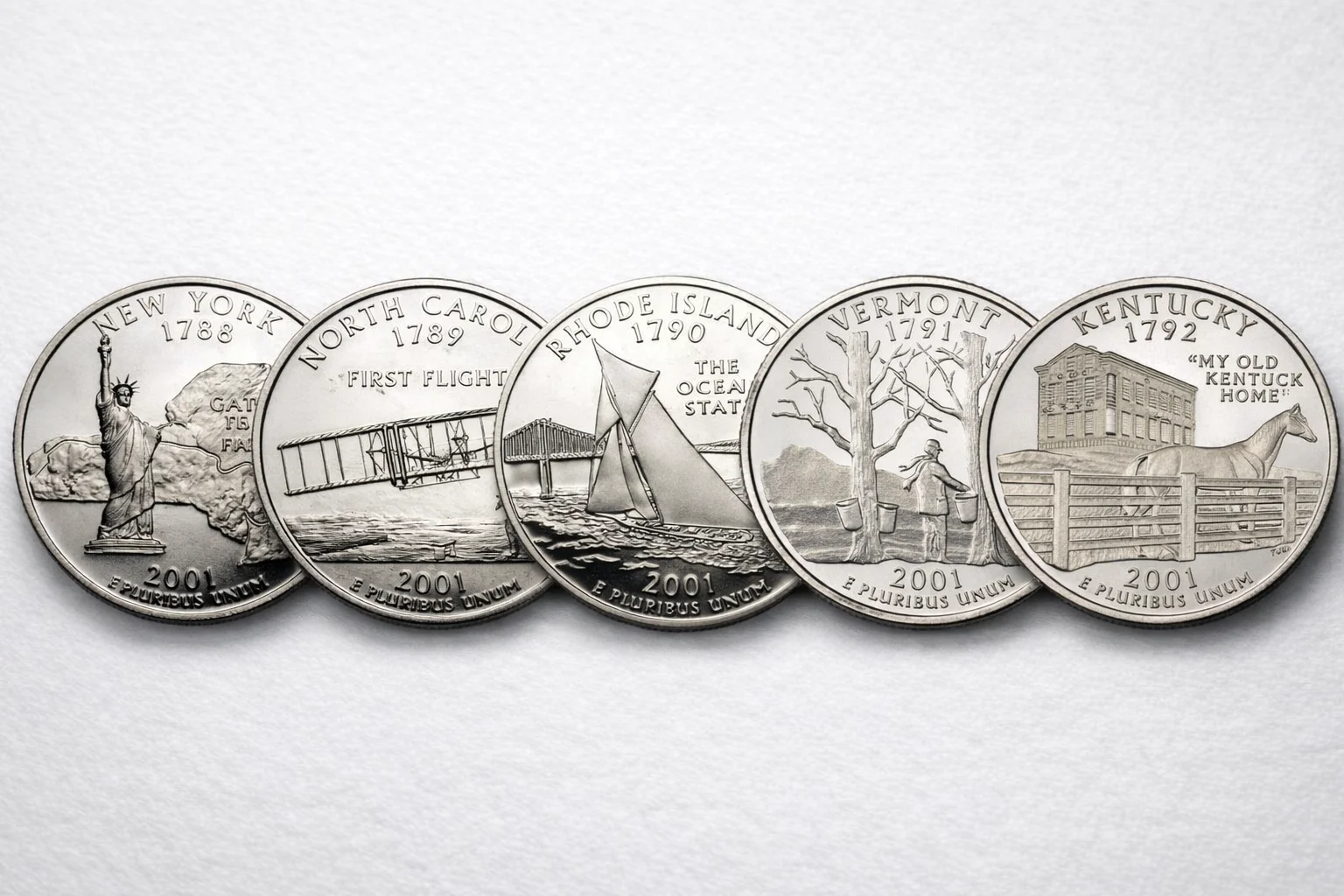
All five designs share the same physical structure:
Parameter | Specification |
Year | 2001 |
Series | 50 State Quarters |
Composition | Copper core with nickel-clad outer layers |
Weight | 5.67 grams |
Diameter | 24.3 mm |
Edge | Reeded |
Obverse Designer | John Flanagan |
The alloy is standard clad. No silver content in circulation issues. Metal does not separate the states, but design and preservation do.
Not every design strikes the same way.
Three factors influence survival:
Relief height
Field size
Fine detail density
High relief areas show contact first. Large open fields reveal marks clearly. Thin lines weaken under die fatigue.
When millions of coins are struck and stored in bags, small design differences become important.
Modern coins mark easily. Early 2000s clad pieces are especially sensitive to bag friction.
The result is a narrow survival window at MS68.
Each 2001 design has its own structural strengths and weaknesses.
The New York quarter features the Statue of Liberty with a detailed skyline in the background.
The skyline introduces fine horizontal lines. These lines depend on a strong die condition. As dies wear, the detail softens quickly.
The open water area beneath the skyline forms a smooth field. This area shows contact marks easily.
Common high-grade issues:
Slight flatness in skyline detail
Light ticks in open fields
Small abrasions on Liberty’s robe
In MS65, these issues are minor. In MS68, they become decisive.
New York can look sharp at first glance. Under magnification, field marks reduce the top-grade population.
The North Carolina design features the Wright brothers’ airplane.
The aircraft includes thin wing lines and a delicate structure. The background includes smooth fields and inscription detail.
Strike strength is important here. Weak strikes blur fine wing lines.
Surface marks often appear in the open sky area. That region shows small abrasions clearly.
In mid-grade Mint State, this design performs well. In MS68, strong wing detail and clean fields must align perfectly.
Strike sensitivity is moderate. Field sensitivity is higher.
The Rhode Island quarter features a sailboat on open water.
This design contains one of the largest smooth field areas among the 2001 issues.
Large open fields mean one thing: marks are obvious.
Even small ticks in the water area reduce eye appeal. The boat detail usually strikes well, but the surrounding space exposes flaws.
MS67 examples are available. MS68 examples require very clean surfaces.
This design is highly sensitive to contact.
The Vermont quarter shows a maple tree with strong central relief.
The tree occupies much of the reverse. This reduces large open field exposure.
High relief means contact appears on the raised leaf areas first. However, the textured tree surface can mask very minor disturbances.
Strike detail is usually solid. The design tolerates small marks better than Rhode Island.
In high grade, Vermont often presents balanced eye appeal. Clean MS67 examples are attainable. MS68 remains selective but not impossible.
Among the five, Vermont tends to hold detail well.
The Kentucky design features a horse head with background architecture.
The horse portrait carries moderate relief. The sky region above forms a smooth field.
Contact marks frequently appear in that sky area. The horse’s face can also show minor friction in high-circulation areas.
Strike quality is generally consistent. Details on the horse usually remain clear.
MS68 requires nearly flawless fields. The design does not hide marks easily.
Kentucky performs steadily in MS66 and MS67. MS68 availability is limited but comparable to Vermont.
In circulated grades, all five designs trade at face value.
In MS63 to MS65, all remain affordable. No state shows sa tructural advantage.
The separation appears at MS67 and above.
Several trends emerge:
Designs with large smooth fields show marks easily.
Designs with central texture hide small flaws better.
Fine skyline or line-heavy elements soften with die wear.
A simplified survival comparison looks like this:
State | Field Sensitivity | Strike Sensitivity | MS68 Scarcity |
New York | Moderate | High | Selective |
North Carolina | High | Moderate | Selective |
Rhode Island | Very High | Low | Scarce |
Vermont | Moderate | Low | Moderate |
Kentucky | High | Low | Selective |
This is not absolute. It reflects general grading experience.
Rhode Island often struggles in MS68 due to open fields. Vermont tends to survive slightly better in top condition because the texture diffuses minor contact.
Below are realistic certified price ranges based on recent market activity.
MS65 – MS66 (Broadly Available)
State | MS65 | MS66 |
New York | $5 – $12 | $15 – $35 |
North Carolina | $5 – $12 | $18 – $40 |
Rhode Island | $5 – $12 | $20 – $45 |
Vermont | $5 – $12 | $15 – $35 |
Kentucky | $5 – $12 | $18 – $40 |
MS65 coins are common across all states. MS66 shows mild separation based on eye appeal and surface quality.
MS67 (Selective Tier)
State | MS67 Typical Range |
New York | $70 – $150 |
North Carolina | $90 – $180 |
Rhode Island | $120 – $250 |
Vermont | $60 – $130 |
Kentucky | $80 – $170 |
At MS67, registry interest begins to influence price. Rhode Island tends to command stronger premiums due to surface sensitivity and lower high-end survival.
MS68 (Condition Rarity Tier)
State | MS68 Typical Range |
New York | $350 – $800 |
North Carolina | $450 – $1,000 |
Rhode Island | $700 – $1,600 |
Vermont | $300 – $700 |
Kentucky | $400 – $900 |
MS68 is the true condition rarity level. Rhode Island often reaches higher results due to the difficulty of preserving large open fields.
Vermont typically trades lower at this level because survival tends to be slightly stronger.
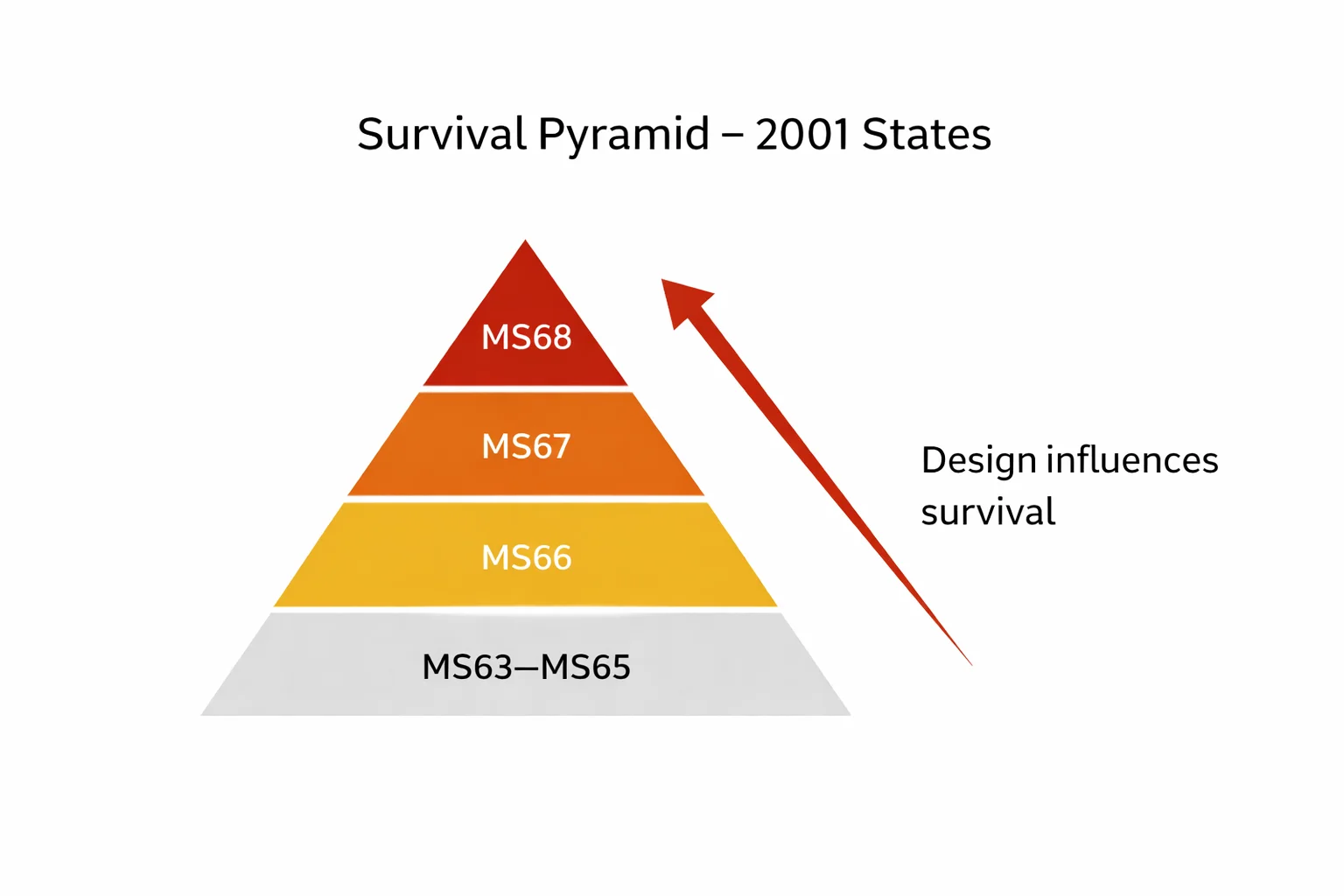
Mid-grade prices remain modest across all states.
MS65 examples are widely available.
MS66 brings visible premiums but a steady supply.
MS67 shows real separation.
MS68 reflects scarcity within the grade, not the rarity of the date itself.
No 2001 state becomes rare in absolute terms.
The premium reflects preservation quality and a limited high-grade population.
Disclaimer
Values represent recent certified U.S. market ranges and exclude exceptional registry-driven auction spikes. Final prices depend on grading service, eye appeal, population shifts, and market demand.
San Francisco struck proof quarters for collectors.
Proof coins differ from circulation strikes:
Polished dies
Mirror fields
Frosted devices
Proof survival is high due to packaging. The grade ceiling shifts to PR69 and PR70.
Design complexity matters less in proof format. Surface preservation matters more.
Proof issues do not influence the circulation of high-grade scarcity directly.
Collectors comparing multiple state designs from the same year often rely on structured references to keep specifications and strike characteristics consistent.
Tools like Coin ID Scanner provide access to an extensive coin database and allow side-by-side review of technical parameters across issues from the same series. What is more, every user can save photos and notes to build a digital collection for future reference.
Accurate attribution supports objective evaluation. Surface quality still decides the outcome.
No single state dominates completely.
Vermont tends to tolerate minor marks better due to its textured central design.
Rhode Island often struggles in ultra-high grade because large open fields expose flaws.
New York requires sharp skyline detail, making early die strikes stronger candidates for MS68.
North Carolina and Kentucky fall between extremes. Both require clean fields and strong luster.
The practical conclusion is simple: High-grade survival depends on design structure, not just production totals.
The five 2001 State Quarters share the same year and alloy. They do not share identical survival patterns.
Most examples remain worth face value in circulation. Mid-grade Mint State coins are widely available.
At MS67 and MS68, design differences become visible. Field size, relief height, and fine detail density influence grade ceilings.
No state becomes rare in absolute terms. Scarcity appears only at the top of the grading scale.
For collectors, the lesson is clear: study the design, examine the fields, and understand where marks appear first. The state name on the reverse comes second.